

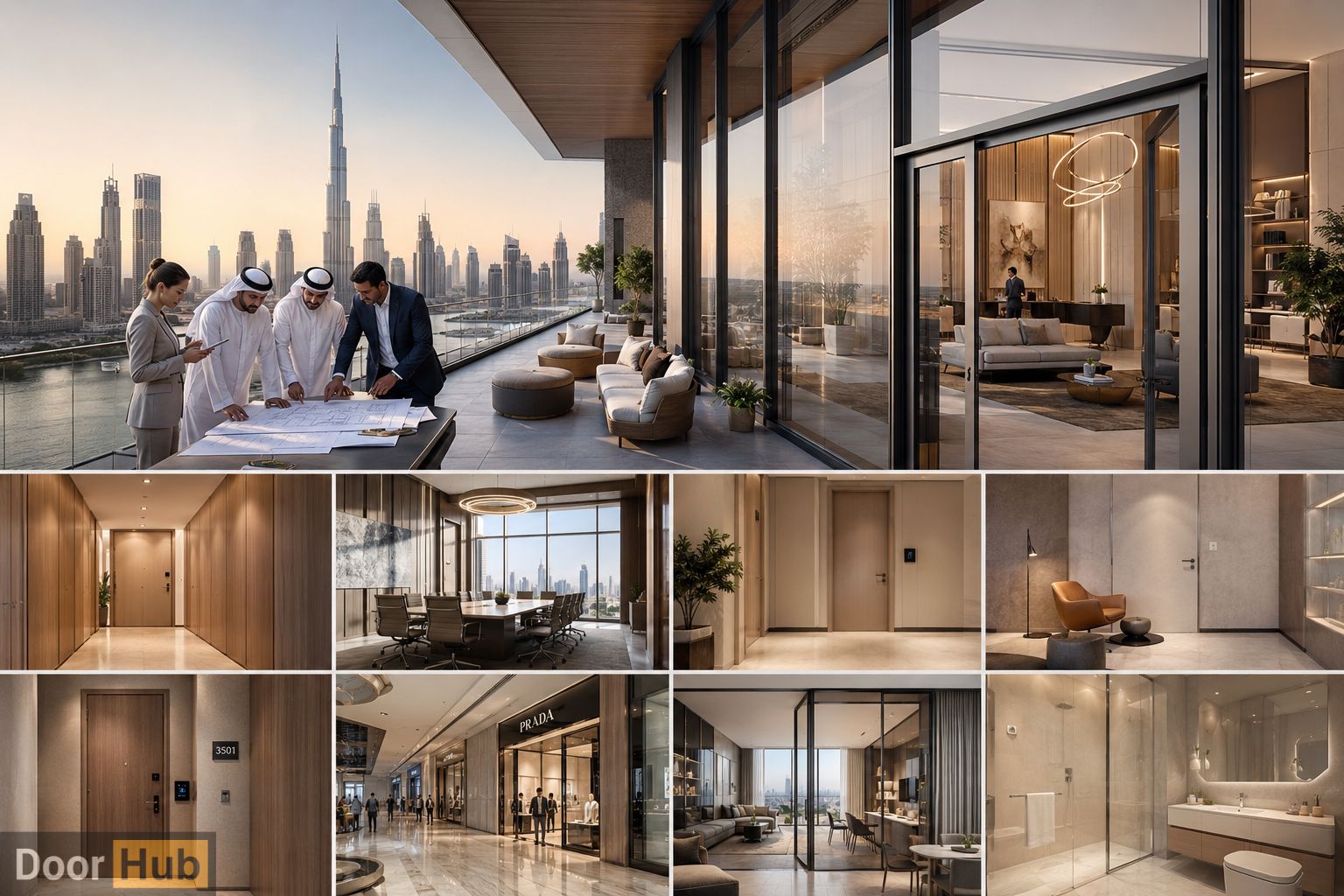
Planning Door Packages for Mixed-Use Developments: A Strategic Guide for UAE Developers
Mixed-use developments have become a defining feature of modern UAE real estate. Residential towers, offices, retail spaces, hospitality facilities, and public amenities are increasingly integrated into a single project, creating vibrant environments that serve multiple user groups.
While this approach offers significant commercial advantages, it also introduces a unique challenge during specification and procurement:
How can a door package be made that satisfies every space's needs without adding needless complexity?
The answer lies in understanding that mixed-use projects require a coordinated system approach rather than individual product selections.
At DoorHub, we regularly support developers, consultants, and contractors who need to balance aesthetics, performance, compliance, and long-term operational value across large developments. This guide highlights the key considerations before finalizing a door package for a mixed-use project in the UAE.
Why Door Packages Have a Greater Impact Than Most Developers Realize
Question: Why should developers pay close attention to door package planning?
Direct Answer:
Because throughout the building lifecycle, doors have an impact on user experience, safety, acoustics, durability, maintenance needs, and project coordination.
Detailed Explanation
Unlike decorative finishes that primarily affect appearance, door systems interact with occupants every day.
A door package with inadequate specifications may cause:
Increased maintenance costs
Tenant complaints
Acoustic issues
Premature hardware failure
Delays during construction
Meanwhile, a well-planned package contributes to smoother operations and better long-term asset performance.
Understanding the Different Functions Within One Development
Question: Why do mixed-use projects require multiple door solutions?
Direct Answer:
Because every zone within the development serves a different purpose and experiences different levels of use.
Detailed Explanation
Consider a typical mixed-use project in Dubai.
The development may include:
Residential apartments
Corporate offices
Retail outlets
Restaurants
Hotel facilities
Shared amenity spaces
Each environment has unique requirements for:
Privacy
Security
Traffic flow
Acoustic control
Fire protection
Attempting to standardize every door throughout the project often creates performance compromises.
Balancing Design Consistency with Functional Performance
Question: Can developers maintain a consistent visual identity while using different door systems?
Direct Answer:
Yes. Modern door systems allow different performance levels while preserving a unified architectural appearance.
Detailed Explanation
A successful mixed-use development should feel cohesive.
Visual consistency does not, however, imply same construction.
For example:
Residential corridors may require acoustic performance
Retail entrances may prioritize durability
Hotel guest areas may focus on privacy and aesthetics
By coordinating finishes, hardware styles, and design language, developers can achieve both performance and visual continuity.
Why Early Door Scheduling Saves Time Later
Question: When should door package planning begin?
Direct Answer:
Ideally during the design development phase before procurement and construction activities begin.
Detailed Explanation
Door packages affect multiple building systems.
Early coordination allows teams to address:
Wall constructions
Opening dimensions
Hardware requirements
Access control integration
Fire-rated assemblies
Waiting until construction has started frequently results in expensive changes and delays in approval.
The Growing Importance of Acoustic Planning
Question: Why are acoustics becoming a major consideration in mixed-use developments?
Direct Answer:
Because modern developments place different activities in close proximity, increasing the need for sound control.
Detailed Explanation
A mixed-use project may contain:
Residential units above retail spaces
Meeting rooms adjacent to public circulation areas
Hotel suites near shared facilities
Noise transfer can have a detrimental impact on user satisfaction in the absence of adequate acoustic planning.
Door systems play an important role in limiting sound transmission and supporting overall building comfort.
Durability Must Match Actual Usage
Question: How should traffic levels influence door specifications?
Direct Answer:
The expected frequency of use should determine both door construction and hardware selection.
Detailed Explanation
Different areas experience different operational demands.
Examples include:
High-Traffic Areas
Main entrances
Retail access points
Public corridors
Moderate-Traffic Areas
Apartment entrances
Office suites
Specialized Areas
Service rooms
Plant spaces
Back-of-house operations
Matching durability to actual usage helps reduce maintenance costs over time.
Why Hardware Decisions Should Never Be an Afterthought
Question: What role does hardware play in overall performance?
Direct Answer:
Hardware is often the most heavily used component of any door system.
Detailed Explanation
Even the highest-quality door leaf can underperform if paired with unsuitable hardware.
Key considerations include:
Hinges
Locks
Door closers
Access control systems
Panic devices
Coordinating these elements early helps avoid installation conflicts and operational issues.
Managing Fire-Rated Requirements Across Multiple Zones
Question: How do fire-rated doors affect mixed-use projects?
Direct Answer:
They are necessary to meet building safety regulations and safeguard inhabitants.
Detailed Explanation
Mixed-use developments typically contain various fire compartmentation zones.
These may include:
Staircases
Service corridors
Utility rooms
Escape routes
Developers should ensure that all fire-rated systems are properly specified, tested, and coordinated with the associated hardware and frame assemblies.
Common Procurement Challenges in Large Developments
Question: What creates procurement difficulties in mixed-use projects?
Direct Answer:
The combination of multiple door types, finishes, and performance requirements increases project complexity.
Detailed Explanation
Large developments often require:
Various door constructions
Different hardware packages
Multiple finish options
Distinct performance classifications
Without clear documentation and coordination, procurement becomes vulnerable to errors, delays, and rework.
A structured approach helps maintain control throughout the project.
How Integrated Systems Simplify Project Delivery
Question: Why do many developers prefer integrated door solutions?
Direct Answer:
Because coordinated systems reduce risk and improve installation efficiency.
Detailed Explanation
When hardware, accessories, doors, and frames are all made to operate together:
Installation becomes easier
Compatibility issues are reduced
Performance is more predictable
Maintenance becomes simpler
This approach is particularly valuable in large mixed-use developments where consistency is critical.
Mistakes That Can Affect Long-Term Building Performance
Question: What are the most common mistakes developers should avoid?
Direct Answer:
Focusing only on initial cost instead of lifecycle performance.
Detailed Explanation
Common errors include:
Selecting the same specification for every area
Ignoring acoustic requirements
Delaying hardware decisions
Underestimating traffic intensity
Overlooking maintenance considerations
These decisions may reduce upfront costs but often increase operational expenses over time.
A Smarter Approach to Door Package Planning
Question: What should developers prioritize before approval?
Direct Answer:
A balance between performance, compliance, aesthetics, and long-term value.
Detailed Explanation
Before finalizing specifications, project teams should review:
Functional requirements for each zone
Fire and acoustic performance needs
Hardware coordination
Maintenance expectations
Future operational demands
A well-planned package supports both successful construction and long-term asset management.
Final Thoughts
Mixed-use developments demand more strategic planning than traditional single-purpose buildings. Door packages must support a wide range of users, functions, and performance expectations while maintaining a consistent architectural vision.
For UAE developers, the most successful projects are those where door systems are considered part of the building strategy—not simply a finishing item.
By focusing on performance, coordination, durability, and future operational needs, developers can create mixed-use environments that deliver lasting value for occupants, operators, and investors alike.
 Consultation
 Taking
 Forming
 Delivery
 Delivery