

Understanding Acoustic Door Ratings: A Practical Guide to STC Performance for Interior Projects
Acoustic comfort is no longer considered a luxury in modern buildings. Whether it is a premium residential development, a corporate office, a hotel, a healthcare facility, or an educational campus, occupants increasingly expect quieter and more comfortable interior environments.
For developers, consultants, and contractors, this often leads to questions about acoustic specifications—particularly STC ratings.
Many project teams see acoustic requirements in tender documents but are unsure how those numbers translate into real-world performance.
What does an STC rating actually tell you about an interior door?
How much sound reduction should a project require?
And why do some doors perform better than others even when they appear similar?
This guide explains the practical meaning of STC ratings and how to evaluate acoustic door systems more effectively in UAE projects.
Why Acoustic Performance Matters More Than Ever
Question: Why are acoustic doors becoming increasingly important?
Direct Answer:
Because modern buildings place greater emphasis on privacy, comfort, productivity, and occupant experience.
Detailed Explanation
Open-plan layouts, mixed-use developments, hospitality projects, and high-density residential buildings create more opportunities for sound transfer between spaces.
Common complaints often involve:
Conversations being overheard
Corridor noise entering rooms
Distractions in meeting spaces
Reduced privacy in offices
A properly designed acoustic door system helps control these issues and contributes to a more comfortable environment.
What Is STC and Why Is It Used?
Question: What does STC actually measure?
Direct Answer:
STC is a standardized method of evaluating how effectively a door assembly reduces airborne sound transmission.
Detailed Explanation
STC stands for Sound Transmission Class.
Instead of describing performance using multiple measurements, STC converts laboratory test results into a single rating that makes comparison easier.
The rating primarily reflects how well a system limits common sounds such as:
Human speech
Office conversations
Everyday indoor activity
The higher the STC value, the greater the sound isolation potential.
Why STC Is More Useful Than General "Soundproof" Claims
Question: Why should project teams focus on STC ratings instead of marketing terminology?
Direct Answer:
because STC offers a quantifiable and uniform standard.
Detailed Explanation
Terms such as:
Soundproof door
Noise-reduction door
Acoustic door
can have various meanings according on the manufacturer.
Because STC ratings are based on accepted testing practices, they offer a more precise point of comparison.
This makes it easier for developers and consultants to compare different systems objectively.
Understanding What Different STC Levels Mean
Question: How can STC ratings be interpreted in practical situations?
Direct Answer:
Different ratings correspond to different levels of speech privacy and noise reduction.
Detailed Explanation
Lower Acoustic Performance
At lower ratings, conversations may still be audible and understandable.
Moderate Acoustic Performance
At mid-range ratings, speech becomes difficult to understand but may still be heard.
Higher Acoustic Performance
At higher ratings, conversations become faint and significantly less noticeable.
Premium Acoustic Environments
High-performance acoustic systems provide strong privacy and are often used in spaces where confidentiality is important.
The appropriate rating depends entirely on the function of the space.
Why Door Construction Plays a Major Role
Question: What influences acoustic performance inside the door itself?
Direct Answer:
The internal construction and material composition significantly affect sound transmission.
Detailed Explanation
Not all door leaves are built the same way.
Performance is influenced by:
Material density
Core construction
Internal layers
Overall engineering
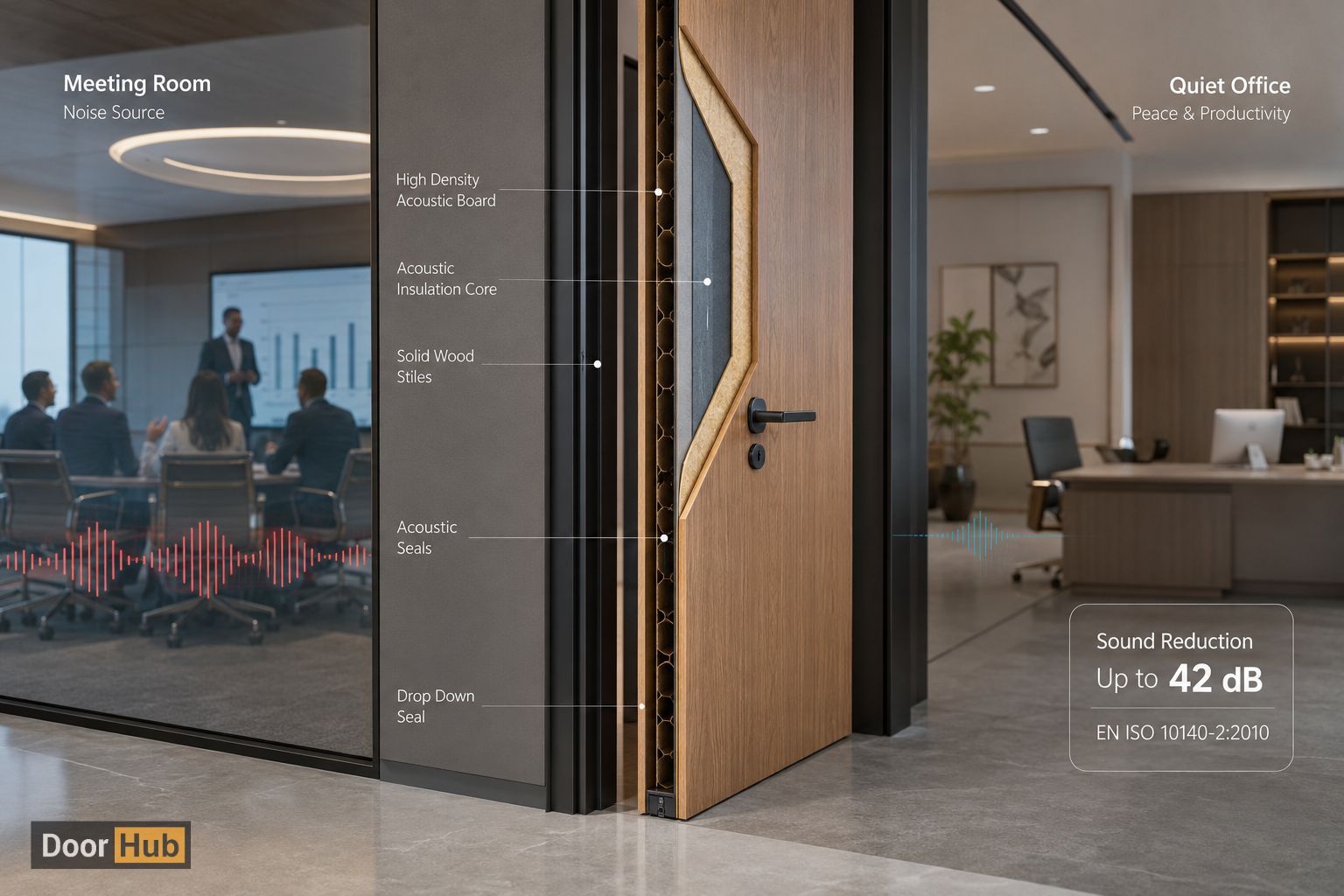
Acoustic door systems are specifically designed to limit vibration and sound transfer through the assembly.
This often requires a more sophisticated construction than standard interior doors.
Why Seals Are Often More Important Than Expected
Question: Can a small gap really affect acoustic performance?
Direct Answer:
Yes. Even minor openings can dramatically reduce sound insulation.
Detailed Explanation
Sound travels through air.
If air can move through gaps around a door, sound can also pass through those openings.
This is why acoustic systems often incorporate:
Perimeter seals
Threshold solutions
Drop-down seals
Specialized gaskets
Without these components, even a high-quality door leaf may fail to achieve its intended performance.
The Difference Between Laboratory Ratings and Site Performance
Question: Will a door always perform exactly as its STC rating suggests?
Direct Answer:
Not necessarily. Installation quality and surrounding construction also influence results.
Detailed Explanation
Laboratory testing occurs under controlled conditions.
Real buildings introduce variables such as:
Wall construction
Frame installation
Hardware integration
Site workmanship
As a result, the actual acoustic experience depends on the complete installed system.
This is why professional installation remains critical for achieving expected outcomes.
Common Applications for Acoustic Door Systems
Question: Which spaces benefit most from acoustic doors?
Direct Answer:
Any environment where privacy, concentration, or comfort are important.
Detailed Explanation
Typical applications include:
Corporate Offices
Meeting rooms, boardrooms, and executive offices often require improved speech privacy.
Hospitality Projects
Guestrooms benefit from reduced corridor and adjacent-room noise.
Residential Developments
Acoustic entrance doors help improve occupant comfort.
Educational Facilities
Classrooms, lecture halls, and training rooms require controlled acoustic environments.
Healthcare Projects
More secrecy is frequently needed in consultation rooms and treatment areas.
Why Acoustic Performance Is a System, Not a Product
Question: What is the most common misunderstanding about acoustic doors?
Direct Answer:
Assuming the door leaf alone determines performance.
Detailed Explanation
Acoustic performance depends on multiple components working together.
These include:
Door leaf
Frame
Seals
Hardware
Installation quality
A weakness in any one area can reduce the effectiveness of the entire assembly.
Successful acoustic design always considers the complete system.
Common Specification Mistakes
Question: What mistakes should developers and contractors avoid?
Direct Answer:
Focusing on numbers alone without understanding how the system functions.
Detailed Explanation
Common mistakes include:
Selecting acoustic doors without proper seals
Ignoring frame performance
Assuming thicker doors automatically provide better results
Overlooking installation quality
Applying the same specification to every area
The real acoustic requirements of each place should be taken into consideration.
How to Choose the Right Acoustic Door Solution
Question: What should project teams consider during specification?
Direct Answer:
The intended use of the space should guide acoustic requirements.
Detailed Explanation
A practical approach includes:
Identifying privacy expectations
Evaluating surrounding construction
Reviewing acoustic requirements early
Selecting complete tested systems
Ensuring proper installation standards
This approach helps create predictable acoustic outcomes throughout the project.
The Growing Demand for Acoustic Interiors in UAE Developments
Question: Why are acoustic specifications becoming more common in UAE projects?
Direct Answer:
Because building users increasingly value comfort, privacy, and premium interior experiences.
Detailed Explanation
Modern developments across the UAE continue to prioritize:
Better occupant wellbeing
Improved workplace productivity
Enhanced residential comfort
Higher hospitality standards
As these expectations increase, acoustic performance becomes an important part of overall building quality.
Door systems play a significant role in achieving these goals.
Final Thoughts
STC ratings provide a useful framework for understanding acoustic performance, but they should never be viewed as the only factor in door selection.
A successful acoustic solution depends on:
Appropriate STC requirements
High-quality door construction
Effective sealing systems
Proper frame integration
Professional installation
For developers and contractors, understanding how acoustic ratings work makes it easier to specify door systems that deliver meaningful performance rather than simply meeting a numerical requirement.
When all elements work together, acoustic doors contribute to quieter, more productive, and more comfortable interior environments across residential, commercial, hospitality, healthcare, and educational projects.
 Consultation
 Taking
 Forming
 Delivery
 Delivery