

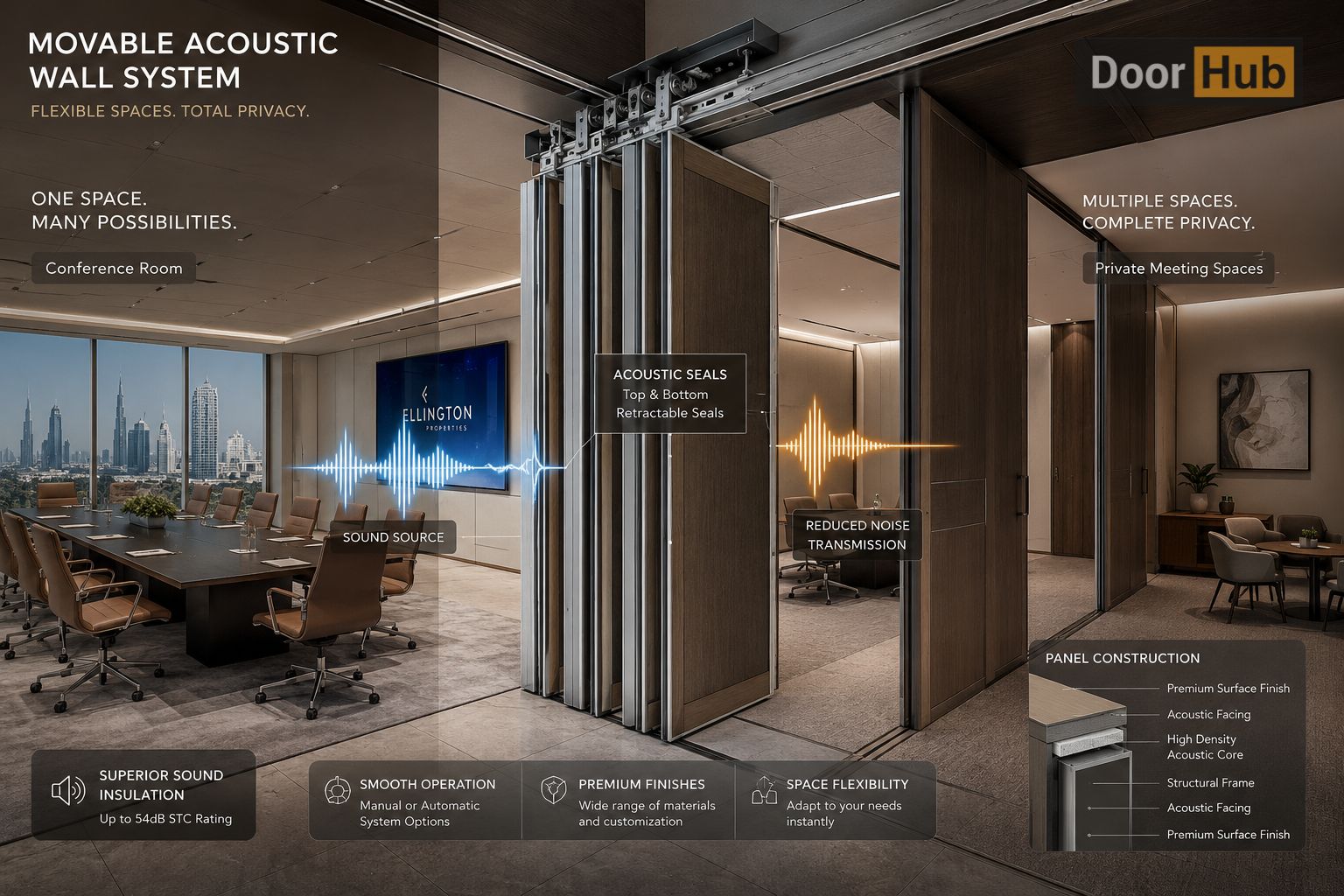
Acoustic Performance in Movable Wall Systems: What Project Teams Need to Know
Flexible interiors are changing the way modern spaces are designed.
Movable wall systems are being employed more often in UAE developments to create spaces that may change to meet evolving operational needs without requiring significant renovation. Offices convert meeting zones into open collaboration areas. Hospitality venues transform one large hall into multiple event spaces. Educational and commercial environments maximize usable floor area through reconfiguration.
However, flexibility poses a technical difficulty that is sometimes overlooked:
How do you maintain meaningful acoustic separation when walls are designed to move?
At DoorHub, acoustic performance is treated as part of overall system design—not as a secondary feature. Developers and contractors can get better results from the start by knowing where sound leakage happens and how moveable systems are designed.
Why Acoustic Control Becomes More Difficult in Movable Systems
Question: Why are movable walls more challenging acoustically than fixed partitions?
Direct Answer:
Because movable walls must combine flexibility with controlled sound separation, which introduces additional technical variables.
Detailed Explanation
Permanent walls benefit from continuous construction and fixed sealing.
Movable wall systems operate differently.
They are designed to:
Open and close repeatedly
Store efficiently
Divide spaces quickly
Maintain alignment over time
This creates multiple transition points where sound can transfer.
Unlike traditional construction, performance depends on how every component works together.
Understanding the Main Sources of Sound Transfer
Question: Where does unwanted noise usually pass through?
Direct Answer:
Most sound leakage occurs at connection points rather than through the panel surface itself.
Detailed Explanation
Developers often focus on panel construction while overlooking the surrounding system.
Typical leakage points include:
Panel Connections
Where adjacent panels meet.
Floor Interfaces
Small gaps can reduce acoustic effectiveness.
Ceiling Integration
Track areas may become transmission paths.
Edge Conditions
Improper compression reduces isolation.
Often, controlling these areas is more crucial than thickening the panels.
Why Panel Engineering Matters More Than Panel Size
Question: Does a larger or thicker movable wall automatically perform better?
Direct Answer:
No. Acoustic performance depends more on engineering than dimensions.
Detailed Explanation
Layered construction ideas are used in the design of high-performance movable walls.
Performance may be influenced by:
Internal material composition
Density management
Structural rigidity
Vibration control
A well-designed panel balances movement requirements with sound reduction objectives.
Visible dimensions alone do not determine acoustic quality.
The Role of Seals in Acoustic Success
Question: Why do acoustic movable systems rely heavily on sealing?
Direct Answer:
Because sound follows airflow, and sealing controls unwanted transmission.
Detailed Explanation
Even expensive panel systems may perform poorly if edge conditions are not controlled.
Acoustic movable wall systems often include:
Vertical edge sealing
Automatic floor seals
Compression mechanisms
Retractable acoustic barriers
These elements create a tighter separation between divided spaces.
Seals greatly enhance real-world acoustic outcomes when properly integrated.
Why Ceiling Track Design Influences Performance
Question: How does the track system affect acoustics?
Direct Answer:
Over time, track systems aid in maintaining alignment and minimizing performance loss.
Detailed Explanation
Tracks are commonly viewed as movement hardware.
In reality, they influence:
Panel positioning
Seal engagement
Operational consistency
Long-term stability
Poor alignment often creates uneven contact between panels, reducing sound control.
Acoustic performance depends on maintaining precision throughout repeated operation.
Why Acoustic Ratings Should Be Evaluated Carefully
Question: Are acoustic ratings enough to select a movable wall?
Direct Answer:
No, ratings shouldn't take the place of system evaluation; instead, they should support decisions.
Detailed Explanation
Acoustic values provide useful reference points.
However, actual performance also depends on:
Installation quality
Ceiling conditions
Panel adjustment
Long-term maintenance
A high-performing system on paper may not deliver expected results if site conditions are ignored.
The complete assembly should always be reviewed.
Common Challenges Seen After Installation
Question: What problems appear most frequently in real projects?
Direct Answer:
The majority of acoustic issues are not caused by wall materials but rather by operational elements.
Detailed Explanation
Typical issues include:
Sound escaping below panels
Reduced seal contact
Panel misalignment
Uneven floor conditions
Track movement over time
These problems usually develop gradually and can often be prevented during planning and installation.
Why Installation Quality Cannot Be Overlooked
Question: Does installation influence acoustic outcomes?
Direct Answer:
Yes. Installation directly affects how the movable system performs.
Detailed Explanation
Acoustic movable walls require controlled tolerances.
Installation impacts:
Panel engagement
Seal compression
Alignment accuracy
Operating smoothness
To ensure desired performance, even sophisticated systems need to be executed carefully.
Installation should be treated as part of the acoustic strategy.
Choosing Acoustic Performance Based on Space Function
Question: Should every movable wall target maximum sound reduction?
Direct Answer:
No, performance ought to be in line with the space's intended use.
Detailed Explanation
Different applications have different expectations.
Examples include:
Meeting and Training Rooms
Balanced flexibility and speech privacy.
Hospitality Spaces
Adaptability with controlled event noise.
Commercial Interiors
Efficient room division with user comfort.
Multi-Purpose Environments
Flexible layouts with practical acoustic separation.
Value and functionality are enhanced when performance is chosen based on real usage.
Mistakes That Often Reduce Acoustic Results
Question: What specification errors should project teams avoid?
Direct Answer:
Many acoustic problems originate from incomplete system planning.
Detailed Explanation
Common issues include:
Selecting based only on appearance
Ignoring track coordination
Overlooking floor conditions
Assuming panel thickness solves acoustic issues
Delaying acoustic decisions until installation
Early coordination generally produces better outcomes.
How DoorHub Approaches Acoustic Movable Wall Solutions
Question: What gives flexible interiors dependable acoustic performance?
Direct Answer:
A comprehensive system approach that takes long-term operation, building, sealing, and movement into account.
Detailed Explanation
At DoorHub, movable wall performance is evaluated as a complete interior solution.
Key considerations include:
Panel engineering
Acoustic detailing
Track coordination
Installation precision
Operational reliability
This approach helps create spaces that remain flexible without compromising comfort.
Final Thoughts
Acoustic performance in movable wall systems is achieved through engineering—not by relying on one specification or product feature.
Successful outcomes depend on:
Intelligent panel construction
Effective acoustic sealing
Accurate alignment
Quality installation
Long-term system consistency
For developers and contractors working on modern UAE projects, understanding these principles helps create adaptable interiors that deliver both flexibility and acoustic confidence.
 Consultation
 Taking
 Forming
 Delivery
 Delivery