

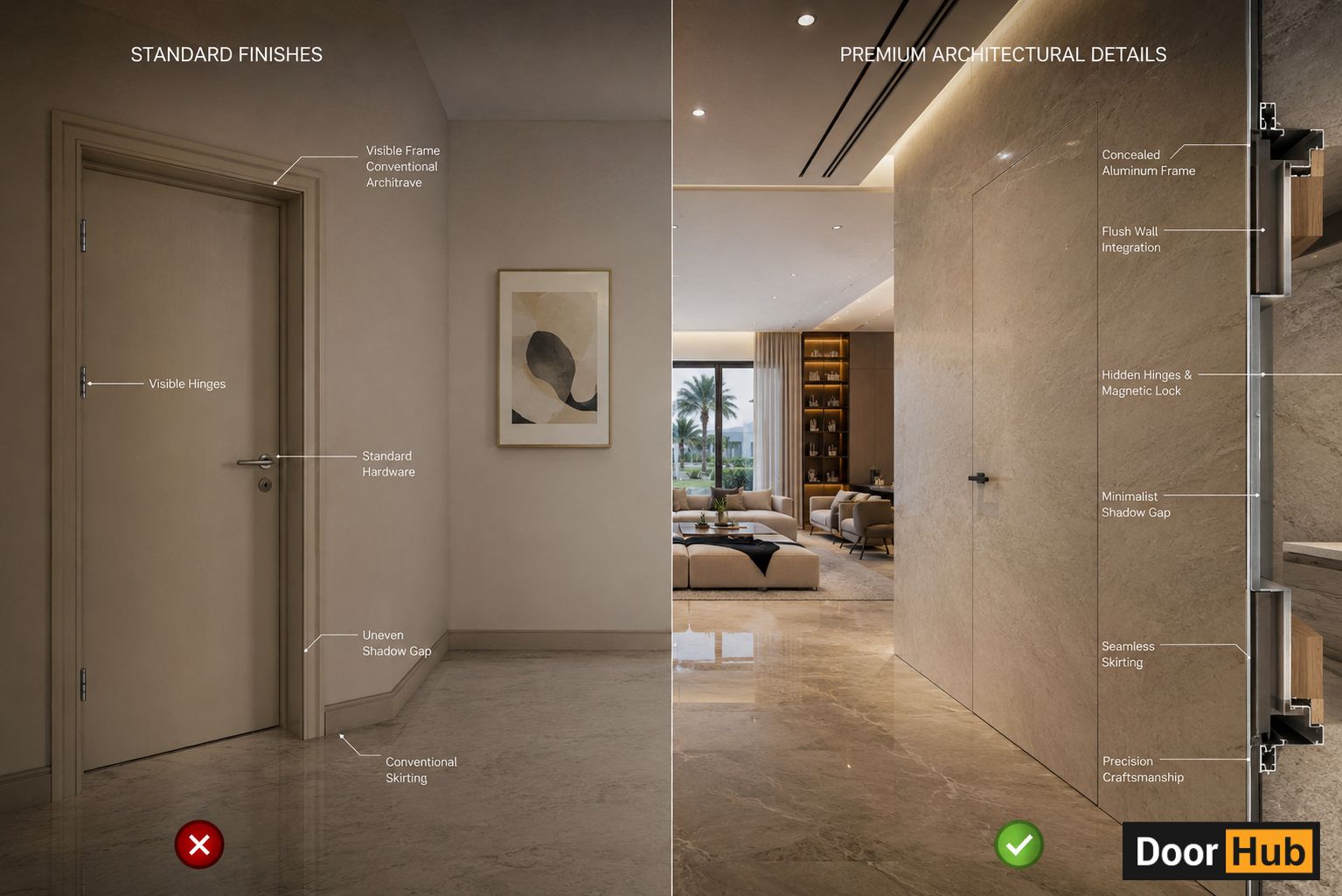
The Handover Moment: How Door Details Decide a Project's Reputation in the UAE
Every development is judged twice. Once on paper, against specifications, budgets, and approvals. And once in person, the day a buyer or tenant walks through the unit for the first time.
That second judgment happens fast, and it rarely starts with the structure. It starts with a door.
Why Handover Day Is the Real Quality Test
Design reviews, structural sign-offs, and contractor inspections all happen before anyone who will actually live in the space sets foot inside it. The buyer's first real inspection is the walkthrough.
At that moment, nobody is checking rebar or load paths. They're opening doors, testing handles, and noticing whether things feel solid or flimsy.
This is why so many disputes and post-handover complaints trace back to joinery and hardware rather than anything structural. It's the layer buyers can actually evaluate themselves.
Five Details That Shape Perception Before a Single Word Is Spoken
Across residential and commercial handovers in the UAE, the same details come up again and again as the deciding factor in how "finished" a space feels.
- Door and frame alignment
A door that sits flush, closes with even resistance, and doesn't require a shove to latch reads as precision. Misalignment — even a few millimeters — reads as rushed work, regardless of how the rest of the unit performs.
- Hardware weight and finish
Buyers physically grip handles and press latches. A handle with real weight and a smooth, cool finish signals quality instantly. Light, hollow-feeling hardware undercuts that impression even on an otherwise well-built door.
- Acoustic and seal performance
A door that closes with a soft, contained sound — rather than a hollow bang or a rattly clatter — suggests engineering care. This matters more in the UAE than in milder climates, since seals also affect how well a unit holds conditioned air.
- Finish consistency from unit to unit
One unit with a clean veneer and another with visible grain mismatch, in the same building, is one of the fastest ways to damage buyer confidence in an entire project — even when specifications were identical on paper.
- Skirting, trim, and transition lines
Where a door frame meets the wall, or where skirting turns a corner, is a small detail that trained eyes and untrained eyes both register subconsciously. Clean transitions read as craftsmanship; visible gaps read as shortcuts.
What Makes the UAE Market Different
Climate is the biggest variable most specifications underweight. Timber and composite doors expand and contract with the region's humidity swings, and cores that aren't rated for those conditions can start sticking, warping, or gapping well within the first year of occupancy.
Buyer expectations are also shaped by a market where premium finishes are the norm, not the exception. In a competitive landscape, a door that feels average can make an entire unit feel average by association, even when every other spec exceeds market standard.
Where Margins Quietly Erode
Value engineering almost always touches doors and hardware at some point in a project's lifecycle, usually late, under budget pressure. The problem isn't the cost-cutting itself — it's cutting in the place buyers are most likely to notice.
Swapping a specified hinge or handle line for a cheaper equivalent can save a modest amount per unit. Across a full development, that saving is rarely worth what it costs in walkthrough impressions, punch-list volume, and post-handover callbacks.
The developments that protect their reputation tend to treat door specification as fixed early and non-negotiable late, rather than as a flexible line item.
How We Approach This at Doorhub
As a UAE-based manufacturer and distributor working directly with developers, engineers, and contractors, this is the layer of a project we specialize in getting right.
Every door leaves our facility with tolerances and core materials matched to local climate conditions, not generic international defaults. Hardware is specified and tested as a system with the door, not bolted on as an afterthought.
We also work directly with project teams during the specification phase, before ordering, to flag where a design choice might create the kind of inconsistency that shows up at handover. That conversation is far cheaper than a post-handover fix.
A Quick Specification Checklist Before You Order
Confirm door core and finish are rated for UAE humidity and temperature ranges, not just a general climate zone.
Standardize hardware specifications across every unit type in the development, not just the show units.
Request a sample installation before committing to a full building order.
Build in a physical walkthrough check — swing, latch feel, seal, and finish — per unit, before handover day.
Treat late-stage hardware substitutions as a flagged risk, not a routine procurement decision.
The Takeaway
Structural quality gets a project approved. Detail-level quality gets it recommended. The two aren't the same conversation, and treating them that way is usually where reputations are won or lost.
If you're finalizing door and hardware specifications for a UAE development, our team can review your current spec sheet and flag anything worth reconsidering before it goes to order.
 Consultation
 Taking
 Forming
 Delivery
 Delivery