

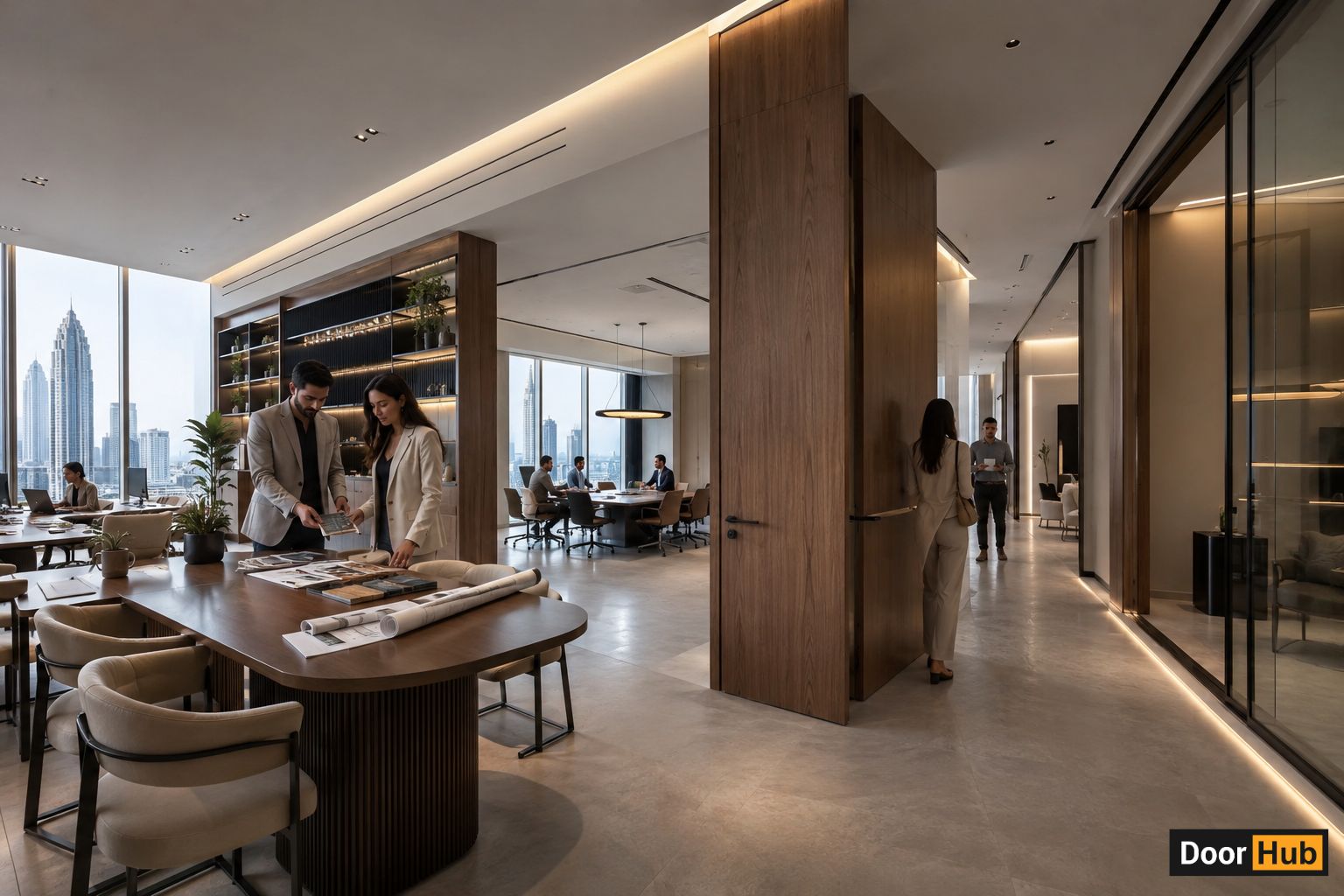
How Doorhub Is Helping UAE Developers Meet the New Standard for Interior Living
Why Are Doors and Interior Hardware Suddenly Part of the Tenant-Retention Conversation?
Direct answer: Because tenants now judge a unit by how well it supports daily life, not just how it looks in photos, and doors are one of the few elements that directly control privacy, noise, and functionality inside a home.
Tenant priorities in the UAE have shifted toward daily usability: a room that can genuinely close off for a work call, a lock that responds to a phone instead of a key, a space that adapts as a household's needs change.
Every one of those daily-use priorities runs through door and hardware specification. That's why this layer of design, once treated as a late-stage procurement item, is increasingly part of early planning conversations.
How Does Acoustic Door Performance Address the Remote-Work Shift?
Direct answer: Since it is the only element that determines whether noise from the rest of the unit disrupts a call or a concentrated work session, a door with adequate acoustic sealing is what truly transforms a spare room into a practical workspace.
Many developers assume a solid-core door is enough on its own. In practice, acoustic performance depends just as much on frame fit, seal quality, and threshold detailing as it does on the door slab itself.
What This Looks Like in Practice
We've seen units marketed as "home-office ready" undermined by a door that doesn't fully seal against the frame, letting hallway or kitchen noise through during exactly the calls a tenant is trying to protect.
Specifying acoustic-rated doors with matched frame tolerances, rather than a standard door dropped into a standard frame, is a small line-item difference that has an outsized effect on how a room actually performs.
What Smart Door Hardware Do UAE Tenants Actually Expect Now?
Direct answer: App-controlled or keypad entry at the main door has moved from a premium feature to a baseline ask in most competitive rental segments, with growing interest in smart locks on interior rooms as well, particularly home offices and storage areas.
Tenants relocating from markets where this technology is already common bring that expectation with them, and increasingly compare units on whether it's present, not just on layout or view.
Where Integration Usually Breaks Down
The most common failure point isn't the technology itself, it's how it's fitted. Smart locks retrofitted onto doors not originally designed for them often show visible gaps, exposed wiring, or hardware that doesn't match the door's finish.
Specifying doors that are pre-prepared for smart hardware, with reinforced strike plates and concealed wiring channels built in at manufacturing, avoids this mismatch entirely and keeps the finish consistent with the rest of the unit.
How Can Door Specification Support Wellness-Focused Interiors?
Direct answer: Beyond acoustics, door specifications have an impact on air movement, daylight flow, and the feeling of openness that wellness-oriented layouts rely on. This is especially true for units that use glazed or partially glass door panels to let light into interior spaces without compromising privacy.
A poorly specified glazed door can create glare or an uncomfortable sense of exposure. The true objective of the majority of wellness-driven design demands is a well-specified one that strikes a balance between light transfer and a true sense of seclusion.
What Should Developers Ask For When Specifying Doors for Flexible or Multi-Generational Units?
Direct answer: Flexible living arrangements require rooms that can be totally closed off when privacy is required and fully opened when it isn't, so ask for doors and frame systems that are made for true reconfiguration rather than just large openings.
Sliding and pocket door systems are increasingly requested for this reason, but they need to be specified with the same acoustic and security standards as a standard hinged door, not treated as a lower-spec alternative.
Units built for multi-generational households or live-in help also benefit from independently lockable interior doors, giving occupants genuine privacy within a shared unit rather than open-plan spaces with no separation at all.
What Mistakes Are We Seeing Developers Make at the Specification Stage?
Direct answer: The most common mistakes are specifying door hardware separately from the door itself, applying upgraded specifications only to show units, and treating acoustic performance as optional rather than functional.
- Splitting door and hardware specification across different suppliers. This frequently results in fit issues, mismatched finishes, or hardware that isn't rated for the door core, all of which surface during handover walkthroughs.
- Upgrading only the units used for marketing. Tenants moving into standard units notice the gap immediately when their door, lock, or seal quality doesn't match what they saw during viewing.
- Treating acoustic sealing as a nice-to-have. In a market where remote work and wellness expectations are now baseline, acoustic performance is functional, not decorative, and skipping it undermines the exact features a unit is being marketed on.
How Does Doorhub Support This Shift in Practice?
We manufacture and specify doors as complete systems, matching core material, acoustic seals, and hardware compatibility from the start, rather than leaving developers to reconcile mismatched components after the fact.
For smart-home integration, our doors can be prepared at manufacturing stage for common lock and sensor systems, so hardware fits cleanly without visible retrofitting.
We also work directly with development teams during early specification to flag where a design brief — home-office ready, wellness-focused, multi-generational — needs a specific door and hardware response, rather than a generic upgrade.
Key Takeaways
Tenant expectations have moved into the daily-use layer of a home, and doors sit at the center of nearly every one of those daily interactions: privacy, noise control, security, and flexibility.
Developers who specify doors and hardware as an integrated system, matched to how a unit will actually be used, are better positioned to meet these expectations consistently across every unit type, not just the ones used for marketing.
If you're specifying interiors for a development targeting these tenant priorities, our team can review your current door and hardware specification and flag where it may fall short of what tenants are now expecting.
 Consultation
 Taking
 Forming
 Delivery
 Delivery