

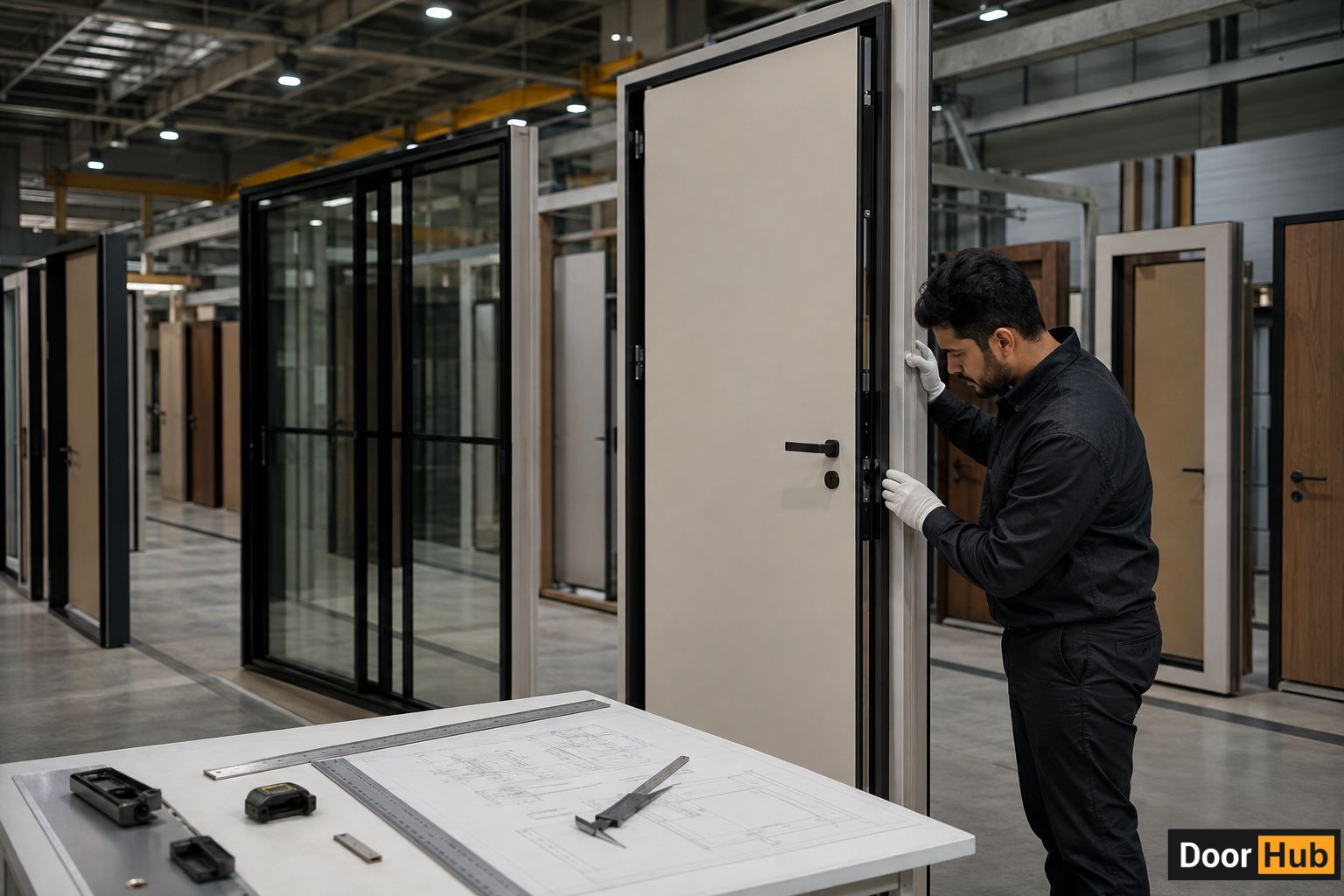
Behind the Checks: The Tools, Tests, and Standards Behind Every Doorhub Door
Talking about quality control in general terms is easy. What actually matters is which tests get run, on how many units, by whom, and what happens when something doesn't pass.
This is the detail behind our process, not the general description, but the actual checks applied before a door reaches a project.
What Specific Tests Does Every Door Go Through Before Approval?
Direct answer: Every door undergoes dimensional tolerance measurement, hardware function testing, moisture content verification, and a visual finish inspection against an approved reference sample, with additional acoustic or fire-rated units undergoing assembly-specific performance checks.
Dimensional and Hardware Testing
Dimensional checks confirm the door and frame meet specified tolerances using calibrated measuring equipment, not visual estimation. Hardware testing includes cycling hinges and testing latch engagement to confirm smooth operation before the unit is approved.
Moisture Content Verification
Core moisture content is measured using a moisture meter at final inspection, not just at material intake, since moisture can shift during manufacturing and finishing. A reading outside the accepted range at this stage holds the unit from approval regardless of how it performed on other checks.
Finish Inspection Against a Physical Reference
Finish quality is checked against a physical approved sample kept on the production floor, not a photograph or general description, since color and texture consistency are easier to judge accurately against a physical reference under consistent lighting.
How Do We Track and Trace Every Unit Back to Its Production Batch?
Direct answer: Every door is assigned a batch reference at manufacturing, recording the material lot, production date, and the specific inspection results for that unit, allowing any door to be traced back to its exact production history if a question arises later.
Why Batch-Level Traceability Matters
If an issue is reported on one unit, batch traceability lets us check whether other units from the same material lot or production run share a common cause, rather than treating each report as an isolated, unexplained incident.
This also allows us to identify a specific batch for closer inspection if an early indicator suggests a potential issue, rather than waiting for problems to surface across an entire order before investigating.
Who Is Responsible for Quality Control on Our Production Floor?
Direct answer: Quality control is carried out by a dedicated QC team separate from the production line itself, so inspection decisions aren't made by the same team responsible for meeting production output targets.
Why Separation of Roles Matters
When the same team is responsible for both production speed and quality approval, there's an inherent tension between those two goals. Keeping QC as an independent function means inspection decisions are based purely on whether a unit meets standard, not on production schedule pressure.
QC staff are trained specifically on inspection criteria and equipment calibration, with defined sign-off authority at each inspection stage before a unit can move to the next stage of production or to dispatch.
What Happens When a Defect Is Found During Inspection?
Direct answer: A defect identified at any inspection stage holds the unit from progressing, triggers a root cause check against that unit's batch and process stage, and results in either rework, if correctable, or rejection and replacement if it isn't.
Root Cause Checking, Not Just Rejection
Rejecting a defective unit without investigating why it occurred only prevents that one unit from shipping. Checking whether the defect traces back to a material batch, a specific process stage, or an equipment calibration issue is what prevents the same defect from recurring across subsequent units.
This is particularly important on large orders, where an uninvestigated defect pattern can affect a meaningful percentage of a production run before it's caught.
How Do We Audit Consistency Across Large Production Runs?
Direct answer: For multi-unit orders, we conduct periodic sampling audits throughout the production run, not just at the start and end, checking that units produced midway through a large order still meet the same standard as the first units off the line.
Why Start-and-End Sampling Isn't Sufficient
A production run can start and end within tolerance while drifting outside acceptable variation somewhere in the middle, particularly across long runs involving material changeovers or equipment adjustments. Periodic sampling throughout the run is what catches that kind of drift before it affects a significant portion of the order.
What Happens If a Defect Is Reported After a Door Has Shipped?
Direct answer: A post-shipment defect report triggers a review of that unit's batch and inspection record, an on-site assessment where needed, and a resolution, repair, replacement, or adjustment, based on findings, with any confirmed pattern feeding back into our inspection process.
If a reported issue traces back to a specific batch or process stage, we check whether other units from that same batch, potentially still on other sites, may share the same risk, rather than treating each report in isolation.
Frequently Asked Questions
Are all units tested individually, or only a sample of each batch? Dimensional, hardware, moisture, and finish checks are conducted on every individual unit; batch-level sampling audits are an additional layer applied throughout large production runs to catch consistency drift.
What equipment is used for quality checks? Checks use calibrated measuring tools for dimensional accuracy, moisture meters for core moisture content, and physical reference samples for finish comparison, rather than visual estimation alone.
Can a specific unit's inspection history be requested for a project? Yes, batch and inspection records can be provided for a project's units on request, supporting submittal documentation or post-installation queries.
How is a recurring defect prevented from affecting future orders? Confirmed defects undergo a root cause check against material, process, or equipment factors, with findings used to adjust the relevant stage of production going forward.
Key Takeaways
Quality control is only as reliable as the specifics behind it: which tests, on how many units, by whom, and what happens when something fails. Individual unit testing combined with batch-level traceability and periodic run audits is what catches both isolated defects and the consistency drift that affects larger orders over time.
If you'd like inspection documentation or batch traceability details for a current or upcoming order, our QC team can provide that alongside your submittal package.
 Consultation
 Taking
 Forming
 Delivery
 Delivery