

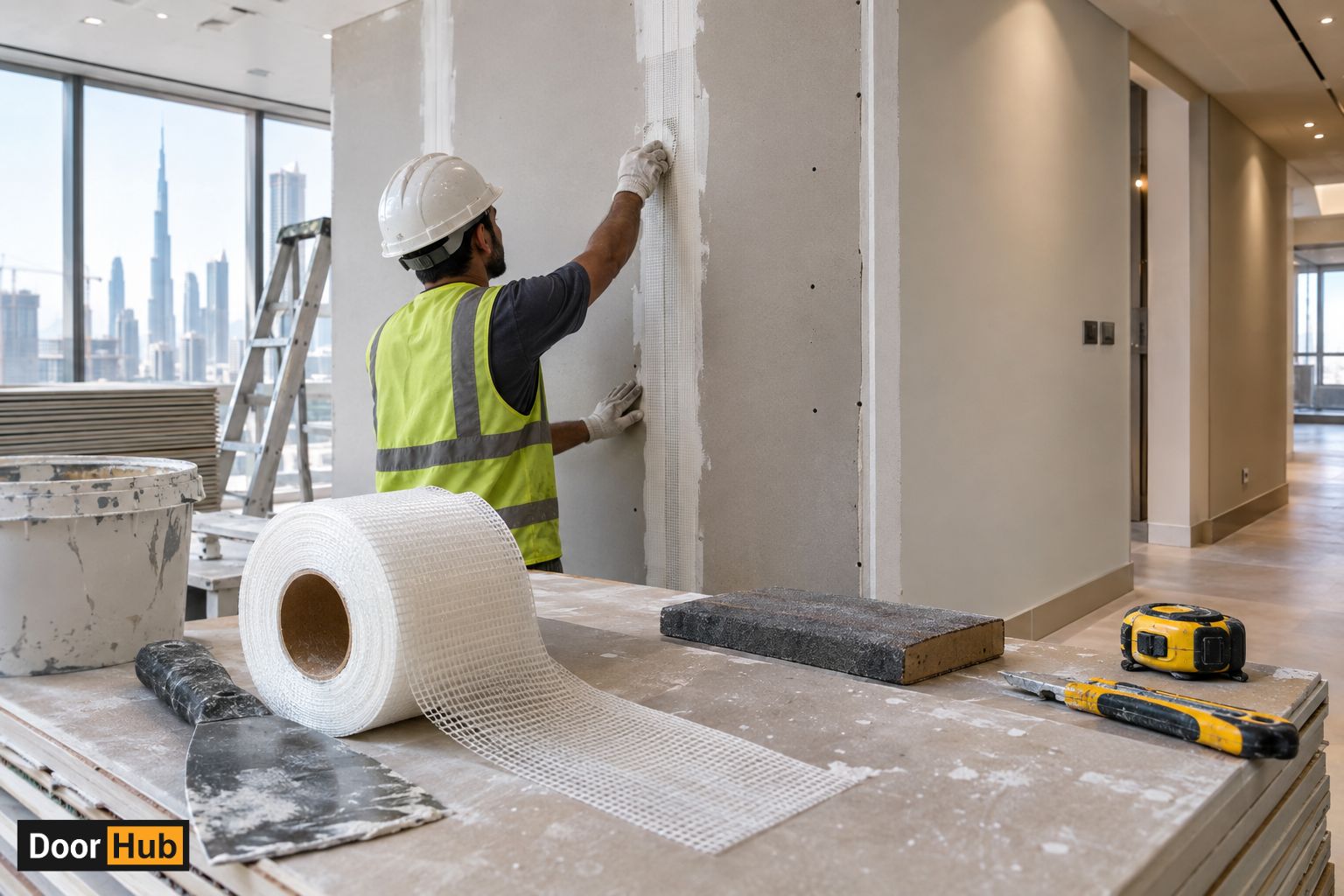
Fibreglass Mesh Tape: The Small Product Behind a Lot of Invisible Work
Most people who walk past a wall have no idea fibreglass mesh tape exists, which is exactly the point. It's one of those products that only becomes noticeable when it wasn't used, or wasn't used properly, and a crack shows up somewhere it shouldn't.
We don't manufacture it. But it shows up constantly around our work, particularly on hidden and flush door installations, so it's worth actually explaining what it is and why it matters more than its size and price would suggest.
What Is Fibreglass Mesh Tape, Really?
It's a thin, open-weave tape made from woven glass fibre yarn, usually with a self-adhesive backing, that gets pressed over a joint, seam, or crack before it's covered with joint compound or filler.
The open weave is the important part. Unlike a solid tape that just sits on top of a surface, the mesh lets compound push through the gaps and grip both sides of the joint underneath. That creates a kind of mechanical anchor rather than just a surface layer, which is why it holds up better in areas that move slightly over time, like the joint between two drywall boards, than a plain paper tape often does.
Where Does It Actually Get Used?
Drywall joints are the most common place people encounter it, wherever two boards meet, that seam is a natural weak point, and mesh tape bridges it before compound goes over the top.
It shows up in crack repair too, plaster or gypsum walls with hairline cracks get taped before being skimmed over, since the tape stops the crack from simply reopening once the wall's repainted. Tile installations over cement board sometimes use a heavier, alkali-resistant version for the same reinforcing reason, and HVAC ductwork uses it for sealing seams in a completely different context entirely.
The common thread across all of these is movement. Anywhere two surfaces meet and might shift slightly, thermally, structurally, or just from age, that joint benefits from something bridging it before a rigid finish goes over the top.
Why Does It Matter So Much on Hidden Door Installations?
This is where it actually connects to what we do. A hidden or flush door is designed to disappear into the wall around it, no visible frame, no visible architrave, just a continuous painted surface that happens to open.
That effect only works if the joint between the door's frame and the surrounding wall is completely invisible once finished. And that joint is exactly the kind of stress point mesh tape exists for, a place where two different materials meet, where the door's frame and the wall's gypsum board don't naturally move in perfect unison every time the door opens and closes.
Without reinforcement at that joint, a fine crack line tends to appear along the door's edge within months, especially with regular use. It's subtle at first, but it defeats the entire purpose of a hidden door, which is to look like there's no door there at all.
How Does This Actually Get Handled on a Hidden Door Installation?
The frame goes in first, set flush with the finished wall plane. Mesh tape gets applied along the perimeter joint between the frame and the surrounding gypsum board, exactly the same way it would along a standard drywall seam.
Joint compound goes over that in a few thin coats, sanded smooth between each one, until the transition from wall to frame is completely level and invisible. Once painted, there should be no visible line at all, just a continuous surface until someone actually pushes the door open.
The tape itself never gets seen by anyone. But it's the reason that seam doesn't reappear as a hairline crack the first time someone leans on the door a little harder than usual, or the building settles slightly over its first year.
What Takes Place If This Step Is Rushed or Ignored?
Compound alone, without the mesh underneath, can bridge a small gap initially, but it has far less resistance to the flexing that happens every time a door swings on its hinge. Over time, particularly with a door used daily, that flexing tends to reopen the joint as a fine crack.
We've seen hidden doors where this step was skipped to save a bit of time, and the result is predictable, a faint line appears along the door edge within the first few months of use, right where the whole design was meant to hide it completely.
It's a small material, easy to treat as an afterthought. On a hidden door specifically, it's doing more work than almost anything else in that installation to keep the illusion actually holding up.
Questions People Ask Us About This
Does every hidden door need mesh tape, or only certain wall types? It's worth using at essentially every frame-to-wall joint on a hidden door, since the movement that causes cracking isn't specific to one wall construction type.
Can this be added after a hidden door is already installed and a crack has appeared? Yes, though it means cutting back the existing joint, applying the tape properly, and reskimming, which is more disruptive than doing it correctly the first time.
Is this the same product used for regular drywall repair around the house? Functionally yes, though the version and weight used around structural joints like a door frame is sometimes a heavier grade than standard drywall-joint tape.
Does using mesh tape add much time to a hidden door installation? Barely any, a few extra minutes per joint, against a finish that's supposed to last the life of the installation without a visible seam ever showing.
The Short Version
Fibreglass mesh tape isn't something anyone specifies for a hidden door because it's exciting. It's specified because the entire point of a hidden door is that nobody notices it's there, and this small, unglamorous strip of woven glass fibre is a big part of what keeps that illusion intact over years of actual use.
If you're planning hidden or flush door installations and want to talk through how the finishing details get handled, we're happy to walk through it.
 Consultation
 Taking
 Forming
 Delivery
 Delivery